- Declare three variables of types int, float, and char. Assign values to them and print their values.
- Write a program that takes two integers as input from the user, adds them, and prints the result.
- Write a program that checks if a given number is even or odd and prints the result.
- Create a program that prints the Fibonacci series up to n terms, where n is taken as user input.
- Write a function to calculate the factorial of a number. Use this function to find the factorial of 5 and print the result.
- Declare an array of 5 integers, initialize it with values, and print them in reverse order.
- Take a string as input and check if it is a palindrome (reads the same backward as forward).
- Create a program that swaps the values of two variables using pointers.
- Define a structure "Person" with attributes name, age, and address. Create a variable of this structure and print its values.
- Write a program that reads content from one file and writes it to another file.
Variables and Data Types:
Input/Output:
Conditional Statements:
Loops:
Functions:
Arrays:
Strings:
Pointers:
Structures:
File Handling:
- Write a C++ program to declare two variables, assign values to them, and then swap their values.
- Create a program that takes an integer as input and prints whether it's positive, negative, or zero.
- Write a C++ program to display the first 10 natural numbers using a for loop.
- Create a program that finds the sum of all elements in an integer array.
- Define a function in C++ that calculates the factorial of a given number.
- Write a program that demonstrates the use of pointers by swapping the values of two variables.
- Create a class representing a "Car" with attributes like model, year, and a method to display information about the car.
- Define a base class "Shape" with a method to calculate area. Derive two classes "Circle" and "Rectangle" from it, and calculate the area of each.
- Write a program that reads data from a text file and displays it on the console.
- Implement a program that handles divide-by-zero exception while taking input for division.
Variables and Data Types:
Control Flow (if-else statements):
Loops (for loop):
Arrays:
Functions:
Pointers:
Classes and Objects:
Inheritance:
File Handling:
Exception Handling:
- What is the difference between int and double in Java?
- Explain the difference between if-else and switch statements.
- How does a for loop work in Java?
- What is the difference between an array and an ArrayList?
- Define the terms "method signature" and "method body" in Java.
- Explain the concept of encapsulation in OOP.
- How does inheritance promote code reuse in Java?
- What is method overloading in Java?
- Describe the purpose of the try, catch, and finally blocks.
- How can you read from and write to a file in Java?
Variables and Data Types
Control Flow
Loops
Arrays
Functions and Methods
Object-Oriented Programming (OOP)
Inheritance
Polymorphism
Exception Handling
File I/O
Web development Topic & Qustions
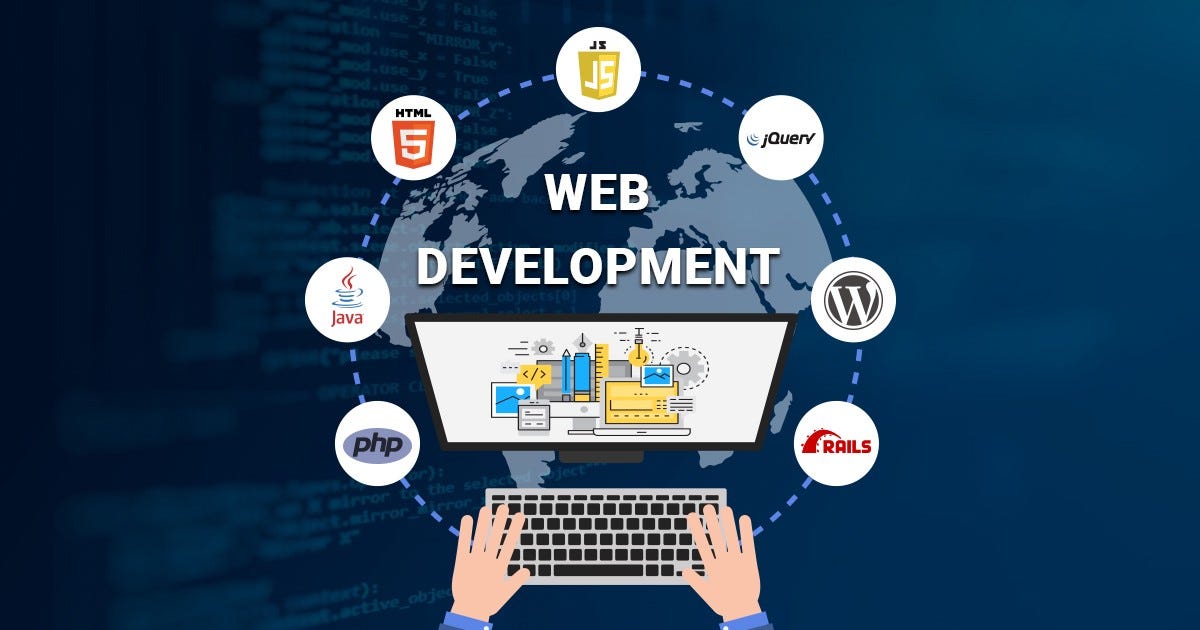
Webdev Topics!
- Explain the purpose of HTML DOCTYPE declaration.
- What is the difference between margin and padding in CSS?
- How do you declare variables in JavaScript?
- How can you dynamically change the content of an HTML element using JavaScript?
- What is a media query, and how is it used in CSS for responsive design?
- Explain the difference between git pull and git fetch.
- What are the key features of the React framework?
- How does routing work in a backend framework like Express.js?
- What are the main principles of RESTful architecture?
- Explain the difference between SQL and NoSQL databases.
HTML
CSS
JavaScript Basics
DOM Manipulation
Responsive Design
Version Control (Git)
Frontend Frameworks (e.g., React, Angular, Vue)
Backend Frameworks (e.g., Node.js, Django, Flask)
RESTful APIs
Database Basics
Then try some Projects
Python Topic & Qustions
Pydev Topics!
- Explain the difference between lists and tuples in Python.
- What is the purpose of the "if __name__ == '__main__':" statement?
- How does a while loop differ from a for loop in Python?
- How can you remove an element from a list in Python?
- Define the term "lambda function" in Python.
- Explain the difference between a class and an object in Python.
- How does inheritance work in Python?
- How can you read and write to a file in Python?
- What is the purpose of the "try", "except", "else", and "finally" blocks in Python?
- How do you import a module in Python?
Variables and Data Types
Control Flow
Loops
Lists and Dictionaries
Functions
Object-Oriented Programming (OOP)
Inheritance
File Handling
Exception Handling
Modules and Packages
Then try some Projects
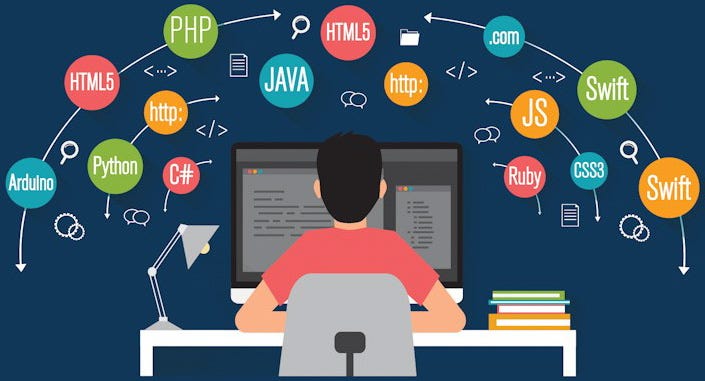
Web Development Quotes
“A successful website does three things: It attracts the right kinds of visitors. Guides them to the main services or product you offer. Collect Contact details for future ongoing relation.”
Github